
Writing Through Rest
Some ways to unlock writing through restful practices


I wrote recently about a showcase I attended locally here in Brisbane for Christian writers. I noted that although this event was informative, it was definitely not restful, and I recall my friend Christine Da Costa saying she had experienced the same thing with women’s retreats growing up (lots of speakers, but not many places to rest, and let thoughts percolate).1
Since the showcase, I have been pondering what are the restful ways I enter into my writing. I actually find the act of writing itself to be a restful practice. It is one way I process my thoughts, my subconscious and spend time with God.
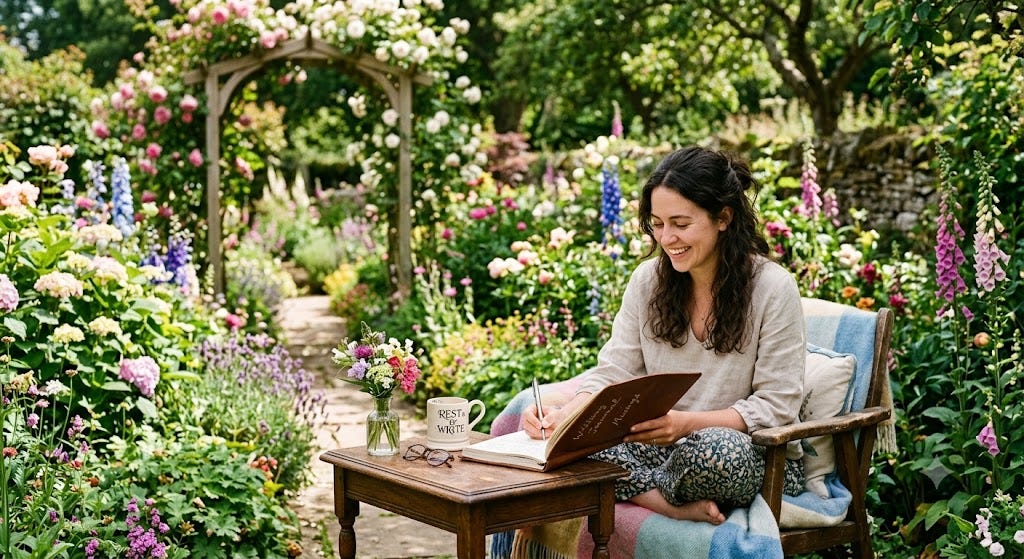
[Picture is AI generated through Gemini]
Some of the particular ways I have found to unlock my writing, while also being practices that I find restful, include the following:
Prayer: I don’t have a particular prayer I recite to prepare to write, but I pray throughout the writing experience, especially when I get stuck. Often if I am writing something based on scripture a lot of questions come up about the meaning or details of the sacred text. I put these questions before God and ask for inspiration. Sometimes it can feel frustrating to not know what to write next. However, I have learnt that God always answers. Sometimes I need to slow down and tune in more so I can hear the answers.
Breathwork: I have participated in some very restful prayer experiences led by Christine Da Costa that have led to me having some wonderful insights that connected to scripture. I have described these experiences here:
What my imagination revealed to me about rest during breathwork prayer

Katie Sampias is author of Her Story of Jesus:
Dancing and prayer: The saying goes dance like nobody is watching. Sometimes I do dance and pray in my head when nobody is watching. I feel there is something about moving my body that can unlock ideas stored in my mind. During a retreat experience with Christine Da Costa, I did dance and prayer session and I did have some writing ideas unlocked, which you can read about here:

Visio Divina: Visio Divina is the practice of praying with a sacred image or work of art. While writing Her Story of Jesus, I found pictures of women from the Gospels particularly helpful stimulate my mind. This helped me to visualise them, and feel the experience they had encountering Jesus. I am particularly drawn to more classical oil on canvas type paintings, rather than more modern depictions of Gospel texts.
I would love to know if others are particularly drawn to particular type of artwork on their writing journeys. Please leave a comment below if you are.
Jungian Dream Theory: I went on a retreat that was about dreams once. We discussed how we can find out things about ourselves through our dreams. I wrote a fantasy piece following this dream retreat, which you can find here:
Reclaiming my inner mermaid

Armelle was tiring. Night was upon her. Not that the night was a real occurrence in the Wood of the Shadow of Dreams. There was always darkness. But from where she sat, resting after a day of wandering, she could look further out over the bay. There towards where it appeared to meet the ocean a horizon was painted and on it she could see orange embers o…
Lectio Divina: I sat with and savoured the relevant passages of the Gospels in the process of writing Her Story of Jesus. This allowed insights from the text to bubble up naturally from a place of deep interior quiet, rather than forced effort.
To read more about what is Lectio Divina and find our more about this practice, I recommend reading this post and guided example by Lahni Blair.

I am pondering all of this and am inspired to create a retreat about Writing Through Rest. Would such a retreat interest you? Please leave a comment below if it would! Watch this space for more details about this!
I asked some other substackers how they unlock their writing, and enter restful spaces to write, and Lahni Blair was so generous to provide this delightful response.
Lahni Blair who writes One Sacred Question
Given the name of my Substack publication, One Sacred Question, you likely won’t be surprised to find out that I love questions! For me, living in a posture of holy curiosity in my everyday life is the pathway towards rest and freedom in my writing.
I see sacred questions as living icons of the heart. In the way one looks at an icon of Christ with the eyes, peering into images to uncover worlds of hidden truth and grace, so too do I ponder and gaze at sacred questions with the eyes of my heart, allowing them to lead me across the threshold of mystery into the heart and presence of Christ. They are gateways into worlds of wonder and surprise: and from those worlds come words and stories that flow naturally from a place of rest in Trinitarian Love.
I think it’s also important to differentiate between rest and certainty. In our extremely intellectual Western culture, it’s easy to assume that curiosity is a quest for answers and that we will somehow be at rest, ready to face the world (or pick up the pen), if we have satisfactory answers. However, holy curiosity is not a search for certainty, it is a quest towards presence: the presence of God. When we learn to live from that Presence, writing (and everything else) becomes a truly restful practice.
Practically, making space for holy curiosity in my everyday life looks like attention and attentiveness. Attention to the life in front of me and attentiveness to how God is weaving a story of presence into my days. While I love engaging with sacred questions in silence and solitude and lengthy times of journaling and exploration with the Lord, that is not always accessible. What is accessible is the constant and steadfast presence of Christ, ready to meet me in my ordinary moments. These are two of my favorite ways to “practice the presence of God”2:
The spiritual practice of Hues & Q’s, a psycho-spiritual prayer practice I crafted for One Sacred Question. Rooted in color and question, it is a simple way to become more aware and attentive to what is going on around you and within you as you journey in friendship with Christ.
Two simple questions on repeat throughout the day-- “Where are you in this moment, Jesus? What are you doing in my heart?”-- and truly stopping to notice and listen, letting curiosity lead the way.
Writing for me is only a restful practice when I am rooted in this kind of presence. When I notice anxiety and fatigue accompanying my writing, it is always an indication that I’ve drifted from curiosity into the ruthless lands of control. For me, curiosity always precedes true rest.
What do you do to rest and unlock your writing? Do you find writing is a restful practice for you? Please leave your thoughts in a comment below!
Christine spoke about why she created Sunflower Sight to create restful spaces for women in this episode of The Profound Moments Podcast -
Episode 1 - Profound Moments - Christine Da Costa and Sunflower Sight

This episode is my first attempt at podcasting. It was a delight to talk to Christine and hear about her life experiences and her ministry of Sunflower Sight. You can find her on Instagram at https://www.instagram.com/sunflower.sight and
a phrase coined by Brother Lawrence in Practicing the Presence of God
 | A guest post by
|
Thanks so much for extending the invitation to collaborate, Katie! I’m looking forward to seeing how others access a rhythm of rest in their writing!
I love this concept of the rest of writing. Thank you for sharing! Looking forward to reading more of your work on here :D